What is a Dog Whistle?
Are You Saying What You Mean?

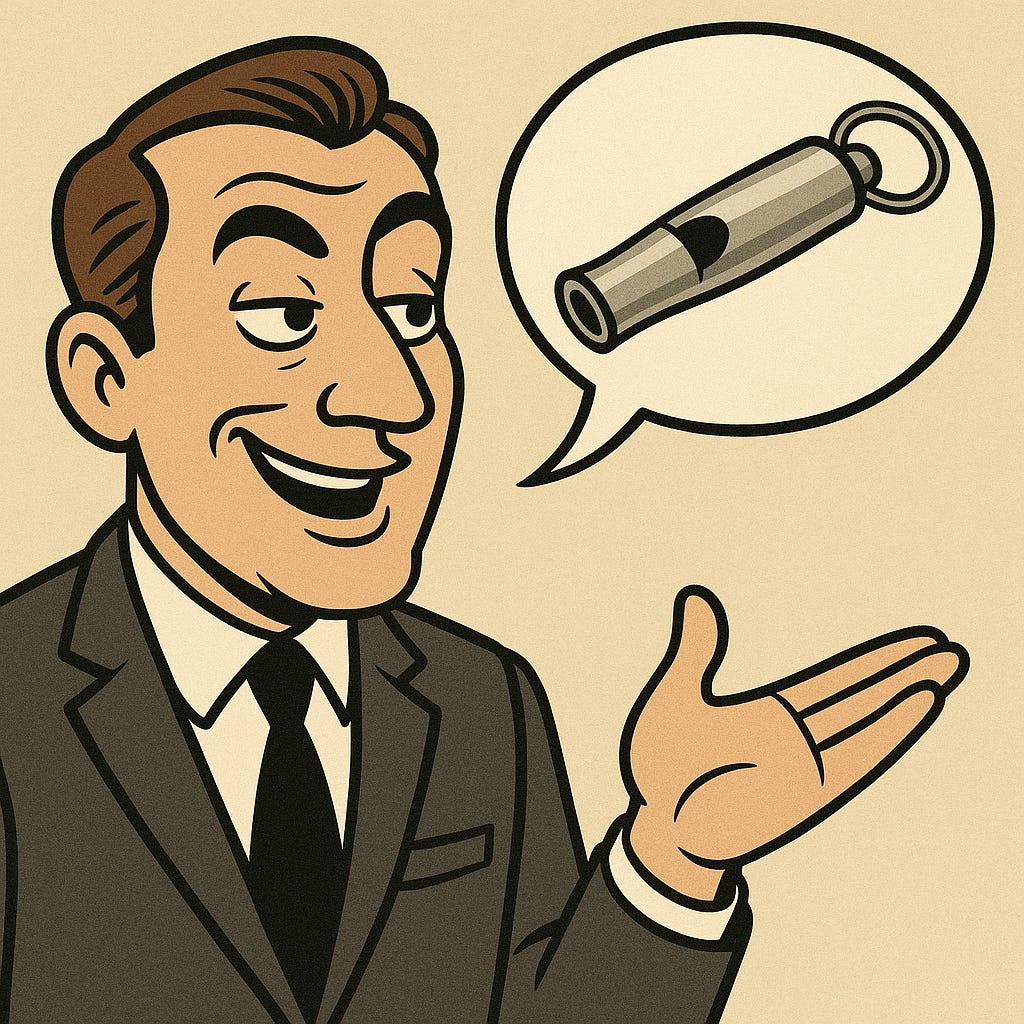
I was going to refer to something in another post as a “dog whistle” but thought it might be worthwhile to define the concept in a separate post first.
You may be familiar with ultrasonic dog whistles - they produce a sound that is too high in pitch for a human to hear, but within the range that dogs can hear.
The utility of such a whistle is that you can reach your intended audience (your dog) without disturbing the people around you.
In much the same way, a rhetorical dog whistle allows you to convey a potentially controversial idea to part of your audience without offending the rest.
Origins
[Much of this section is sourced from Wikipedia]
The term seems to have first been related to politics by opinion pollsters. Richard Morin, director of polling for The Washington Post, was quoted by William Safire as writing in 1988:
subtle changes in question-wording sometimes produce remarkably different results ... researchers call this the “Dog Whistle Effect”: Respondents hear something in the question that researchers do not.
Earlier than that, in 1981, former Republican Party strategist Lee Atwater, when giving an anonymous interview discussing former president Richard Nixon’s Southern strategy, speculated that terms like “states’ rights” were used for dog-whistling:
[I’m going to replace the original usage of the N-word here with “N*”]
You start out in 1954 by saying, “N*, n*, n*.” By 1968, you can’t say “n*” – that hurts you. Backfires. So you say stuff like forced busing, states’ rights, and all that stuff. You’re getting so abstract now, you’re talking about cutting taxes. And all these things you’re talking about are totally economic things and a byproduct of them is [that] blacks get hurt worse than whites. And subconsciously maybe that is part of it. I’m not saying that. But I’m saying that if it is getting that abstract, and that coded, that we are doing away with the racial problem one way or the other. You follow me – because obviously sitting around saying, “We want to cut this” is much more abstract than even the busing thing, and a hell of a lot more abstract than “N*, n*.”
Related
A concept that is closely related to a dog whistle is a “fig leaf”. A biblical reference to Adam and Eve who used fig leaves to cover their shameful parts, a fig leaf is a statement intended to “cover” or soften a controversial statement.
For example, one might say, “I am proud to call myself a nationalist”, which will communicate one thing to your intended audience while simply being heard as “patriot” by the majority. As a fig leaf you might add one or two statements that support patriotism but not necessarily nationalism.
What dog whistles and fig leaves provide the speaker is plausible deniability - the ability to imply something extreme but claim that’s “not what I said”.
Examples
In United States politics, some common dog whistles and their alleged undertext are:
States’ Rights - originally associated with school desegregation. More recently efforts at the federal level related to gender, abortion, and diversity.
[Rich] International Bankers / Globalists - anti-semitism
Woke - has been used to invoke both race issues as well as gender issues
I’ll be frank: many of the examples are racial in nature and often the political right are the ones accused, but there are also cases where those on the political left have been accused. For example:
“end welfare as we know it” and increase the “war on crime”. - spoken by Bill Clinton and seen by some as coded signals to attract white voters who harbored racial anxiety about minorities and crime.
“heartland” or “midwestern” voters - white
The concept is not limited to politics, either. Apparently, “in the United Methodist Church (UMC), the phrase “scriptural holiness” has been used to signal adherence to sola scriptura theology, which emphasizes the Bible alone as the ultimate authority and diminishes the role of tradition and reason.”
Where Do We Hear Them?
In the past, use of the dog whistle may have largely been limited to political speeches. But with the rise of talk radio, partisan cable news and social media, terms are more quickly and widely shared and repeated. You may see these terms on Facebook, your friend’s blog, or in a sermon.
I’m inclined to believe that many speakers repeat these terms unwittingly, not fully understanding what they convey to some, and not necessarily aware of the assumptions of their audience.
From years in church I know that there are some words in scripture that we pause and define. When a passage speaks of “a perfect man”, we stop and explain that in this case perfect does not mean “sinless” but “spiritually mature”.
In the same way, pastors and Sunday School teachers should be aware of some of the common dog whistles so they can be sure they are speaking clearly.
In the case of the word “woke” I would advise extra caution. This one has become somewhat of a “skunked term” [https://en.wikipedia.org/wiki/Skunked_term] as it has gone from a meaning of “alert to discrimination” to becoming a catch-all negative term to invoke various racial / gender concerns.
If you are using “woke” in the negative sense, people are very likely hearing things you may not intend.